

Most students come to us having already decided on a university. They’ve seen it on a YouTube video, a cousin mentioned it, or it came up first when they Googled the course. By the time they’re sitting across from us, they’ve emotionally committed and that’s usually when the real problems start. Choosing a university abroad isn’t the same as choosing a local one. There are layers most students don’t think about until it’s too late to change course. Here are the seven we see skipped most often.
1. Ranking vs. Recognition
They’re Not the Same Thing A university ranked 400th globally can still open more doors in your field than one ranked 50th depending entirely on where you want to work afterward. Global rankings measure research output and academic reputation. Your future employer measures whether they’ve heard of the place and whether graduates from it tend to perform well. Before you fixate on a league table position, ask: is this university known in the industry I’m targeting? A business school with strong corporate hiring partnerships in London is worth more to a finance graduate than a higher-ranked institution with no employer relationships. Check graduate employment outcomes, not just rankings.
2. The City Matters as Much as the Campus
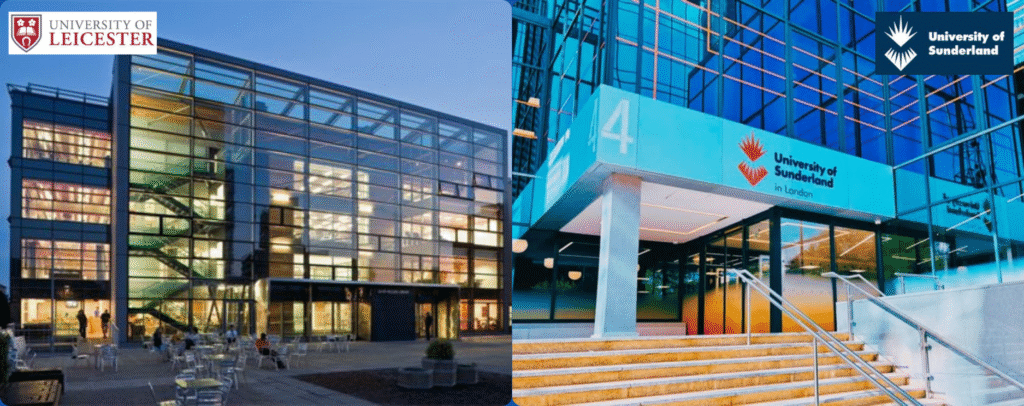
This is the one students dismiss the fastest and regret the most. Where a university is physically located shapes almost everything your cost of living, your part-time work options, your social life, and your job prospects after graduation. London is exciting and full of opportunity, but rent alone can consume a third of a student budget. Sunderland costs a fraction of London. Leicester sits in the middle. Neither is wrong but choosing based on the university name without checking what the city actually costs you per month is a mistake we see constantly.
3. Entry Requirements Are a Starting Point, Not the Full Picture
Published entry requirements are minimums. Some universities accept students just below those minimums with a strong personal statement. Others enforce them strictly even for students who narrowly miss. Some require a specific IELTS band across all four components; others look at the overall score and flex on individual sections. If you’re applying with a GPA that sits just below what’s listed, don’t assume you’re out. Don’t assume you’re in either. The answer lives in the detail of how each university handles borderline applications and that varies more than people expect.
4. Scholarship Deadlines Often Don’t Match Application Deadlines
This is the one that costs students real money. University applications and scholarship applications are often two completely separate processes with different deadlines, different documents, and different decision timelines. A student who applies for a course in March might have missed the scholarship window that closed in January. If funding matters and for most Sri Lankan families it does start with the scholarship deadline and work backwards from there. Not the other way around.
5. Course Content Varies More Than the Course Name Suggests
Two universities can both offer an MSc in International Business and deliver entirely different programmes. One might be heavily quantitative with a focus on finance and supply chains. The other might sit closer to strategy and culture. Neither is wrong but one might suit you considerably better. Look at the module list, not just the course title. Check whether the final assessment is a dissertation, a project, or a combination. If you hate exams and the programme is 80% exam-assessed, that information matters before you apply.
6. Post-Study Work Rights Depend on Where You Study, Not Just Which Country
In Australia, studying at a regional campus rather than a capital city campus can give you additional points toward permanent residency under the regional migration pathway. In the UK, all Student Route visa holders get access to the Graduate Route but the quality of graduate employer connections varies enormously between institutions. If staying on after graduation is the goal, research what the university’s graduate employment rate looks like specifically for international students not the overall figure, which is typically skewed by domestic graduates.
7. Accreditation Is Not Universal
A degree that’s fully recognised in the UK is not automatically recognised in Sri Lanka, Australia, or the UAE. If you’re planning to return home and work in a regulated profession engineering, accounting, medicine, law you need to verify that the qualification will be recognised by the relevant professional body in your target country before you apply, not
Leave a Reply